
Entertaiment
Christmas, Film, and the Christian Stereotype | Entertainment News


Bollywood’s Portrayal of Christians: A Journey Through Stereotypes and Sensitivity
As we celebrate Christmas, it’s a fitting moment to reflect on the nuanced and often problematic portrayal of the Christian community in Bollywood films. For decades, the Hindi film industry has oscillated between reinforcing stereotypes and showcasing moments of empathy.
The Shadow of Stereotypes
Historically, Bollywood’s representation of Christians has frequently leaned on caricatures. Many characters we’ve seen on screen–drunkards, vamps, and morally dubious secretaries–have confined Christian identities to predictable tropes. In contrast to the more nuanced portrayals of Muslim characters as friendly neighbors, Christians have often been portrayed through a lens of ridicule.
Iconic film scenes, like Pran dancing with liquor bottles in Majboor (1974), highlighted this absurdity. The infamous ‘Mona Darling’ trope, exemplified by the legendary villain Ajit, created an unfortunate caricature of Christian women. The characters often bore the burden of exaggerated accents, amplifying the two-dimensional portrayal of the community.
A Glimmer of Dignity: Breaking the Mold
Despite the overwhelming presence of negative stereotypes, significant exceptions have emerged. Hrishikesh Mukherjee’s Anari (1959) introduced Mrs. D’Sa, a tough but nurturing character that challenged existing norms. Yet, her heavily accented English set a linguistic template that would echo across future portrayals.
The turning point came with Amar Akbar Anthony (1977), where for the first time, a Christian character was not merely a sidekick or a caricature but a full-fledged hero. Amitabh Bachchan’s portrayal of Anthony Gonsalves remains iconic, injecting a degree of respect into Christian characterizations that had previously been lacking.
Noteworthy Depictions of Christian Women
The portrayal of Christian women in Hindi cinema has evolved, albeit slowly. The 1975 film Julie faced public backlash for its unfavorable depiction of a Christian family, whose dysfunction was portrayed as the norm. In contrast, Ankhiyon Ke Jharokhon Se (1978) attempted a more nuanced approach with Lily, a working-class Christian girl. While sympathetic, her background still leaned towards economic struggle, illustrating that the full dimensionality of Christian characters was still under construction.
Films such as Baton Baton Mein (1979) and Albert Pinto Ko Gussa Kyun Aata Hai (1980) brought forth meaningful portrayals that eschewed stereotypes. Instead, they depicted Christian characters as ordinary people navigating their cultural identities, exemplifying a more authentic representation.
Modern Perspectives: A Mixed Bag
In contemporary cinema, we see glimpses of progress and regression. Karan Johar’s Kal Ho Naa Ho (2003) stands out as a modern classic, presenting Christian characters with depth and dignity. The portrayal of Naina Catherine Kapur, played by Preity Zinta, and her mother Jennifer, embodied a shift toward normalcy and complexity. Yet, this nuanced representation often sits alongside troubling portrayals that reinforce existing stereotypes.
For instance, films like Sins (2005) pivot back to sensationalist narratives involving Christian clergymen, while Cocktail (2012) recycles the tired narrative of dysfunctional Christian families. The portrayal of hyper-sexualized characters as mere punchlines continues to undermine years of gained authenticity, manifesting a dichotomy within the representation.
Regional Cinema: A Study in Contrast
Contrasting sharply with Bollywood, Malayalam cinema consistently provides rich, nuanced portrayals of the Christian community. Films often depict the community as integral to Kerala’s vibrant social fabric. Recent films like Lokah – Chapter 1: Chandra exhibit a unique blend of cultural reverence, integrating folklore with Christian themes seamlessly.
Bengali cinema, too, has shown a degree of sensitivity, with films like Bow Barracks Forever (2004) exploring the Anglo-Indian community with respect and authenticity.
The Need for Authentic Representation
Despite progress from the days of caricatures and clichés, true normalization remains an elusive goal in Bollywood. The community is still underrepresented in complex narratives where faith is only a backdrop rather than a core aspect of identity. When was the last time we witnessed a major film that features a Christian protagonist without their faith being a focal point?
Bollywood has indeed traveled a distance since the era of the Mona-Darlings. However, the onus now lies on filmmakers to deliver deeper, more authentic representations, reflecting the true diversity and complexity of the Christian community. As Kal Ho Naa Ho demonstrated over two decades ago, the potential for genuine storytelling is waiting to be harnessed.

The Enigmatic Arabian Sea in “Songs of Sundari”
A Coastal Narrative
In the short film Songs of Sundari, director Sudarshan Sawant transports viewers to the crowded and vibrant waterways of the Versova-Madh creek, showcasing the Arabian Sea’s multifaceted identity. A blend of mystique, livelihood, and a hub of divinity, the film emerges at a crucial time when the construction of a ₹2,395 crore bridge connecting Versova to Madh Island is underway. This infrastructural change promises to reduce travel time dramatically, shifting the experience of the local communities, especially the Koli fisherfolk.
Impact on the Koli Community
The bridge’s development will shorten the travel time from 90 minutes to just 5 minutes, posing a dire threat to the Koli community who have called these waters home for generations. This indigenous population relies heavily on the sea for their livelihoods through fishing and ferry services. With the advent of this new structure, the ferry businesses are poised for a significant decline, pushing the Kolis further into the margins of Mumbai’s rapid urban transformation.
Poignant Reflections
Sawant’s film does not preach; rather, it serves as a poetic meditation on the changing dynamics of the sea. As a voice in the film poignantly remarks, “When nature changes, it doesn’t betray itself.” This line encapsulates the stark reality that the sea’s grace is slowly fading amidst infrastructural advancements that prioritize convenience over traditional ways of life.
Sawant’s Filmmaking Journey
Sudarshan Sawant, a 36-year-old filmmaker and FTII graduate, has an intrinsic connection to the landscape he documents. Living on Madh Island, he decided to explore the universe surrounding his daily ferry commute, crafting Songs of Sundari—the first installment of a proposed Boat trilogy. With plans for subsequent films focused on Thane Creek and another site in Navi Mumbai, his passion for storytelling shines through.
Artistry in Storytelling
In Songs of Sundari, the true protagonists are the sea and the weary boats navigating its waters. Sawant captures the essence of life around the creek, documenting the hustle against the backdrop of a landscape increasingly marred by industrial encroachment. The visuals lack a linear narrative but are rich in emotional weight, portraying the tension between nature and development.
Evocative Sound Design
Sawant’s expertise in sound further elevates the film’s impact. Avoiding direct interviews, he allows the audience to draw their own conclusions through the film’s auditory landscape. The combination of haunting melodies, including an evocative hum by Sneha Sundar, creates a sensory experience that lingers long after viewing.
Voices of Innocence
A notable aspect of the film is its use of childlike narration to address the profound changes experienced in the sea. A young boy articulates his observations succinctly, providing an unfiltered perspective free from societal judgments. His revelations about the lack of fish due to industrial activity evoke a sense of loss, emphasizing the depth of the sea’s plight.
Visual Poetics
The film’s visual language is striking. Night scenes envelop the narrative in mystery, while day sequences are often over-exposed to capture the chaotic essence of construction sites. The titular boat, named Sundari, serves as a metaphor for resilience, embodying the delicate balance between community and the looming threat of development.
Festival Recognition
Songs of Sundari has garnered international attention, being showcased at prestigious festivals, including Vision du Réel in Switzerland and the Beijing International Short Film Festival. Each screening evokes rich discussions about cultural preservation amidst progress.
Artistic Vision and Goals
The modest budget of ₹3 lakhs reflects Sawant’s dedication, encapsulating a nuanced exploration of life’s intricacies along the Arabian Sea. With the film presented in Marathi and English subtitles, it aims to resonate across linguistic boundaries, inviting numerous viewers to witness the silent dialogues of the waters.
Through thoughtful storytelling and a nuanced portrayal of community, Songs of Sundari resonates deeply with contemporary issues, making it a vital cinematic piece in today’s rapidly evolving urban landscape.
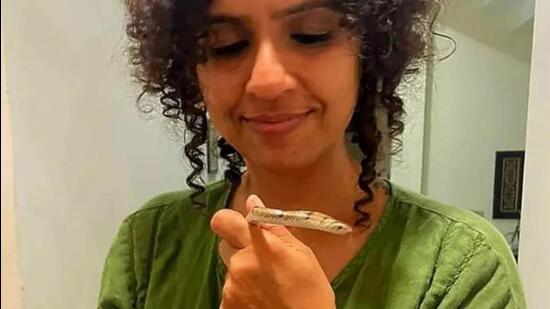
Jyoti Raghavan: A Compassionate Guardian of Snakes in Gurugram
When a snake appears in a residential area, panic often ensues. Doors slam shut, people rush indoors, and the atmosphere becomes charged with fear. But for Jyoti Raghavan, a 49-year-old snake rescuer in Gurugram, such sightings are not just everyday occurrences; they are moments calling for compassion and intervention.
Urban Challenges and Snake Rescues
Raghavan relocated to Malibu Town in Sector 47 of Gurugram in 2018, and since then, she has developed a keen understanding of the local wildlife, specifically snakes. Earning a reputation as Gurugram’s only woman snake rescuer, her journey into this unique vocation began nearly 15 years ago in Dwarka, Delhi.
The Awakening Moment
One memorable winter afternoon, Raghavan encountered a distressing scene: a majestic cobra was being mercilessly beaten by onlookers in her housing society. “It was seeking warmth under some plastic pipes,” she recalled. “To witness such cruelty for simply being a snake felt profoundly unjust.” Fueled by a mix of instinct and empathy, she declared her intention to rescue the cobra. Armed only with a sack and a bamboo stick, Raghavan successfully guided the cobra to safety and released it into the wild.
The Ripple Effect of One Rescue
This first act of intervention was transformative. What started as a heroic rescue morphed into a lifelong commitment. Years later, after moving to Gurugram, she found another snake in need: a harmless wolf snake entangled in her garden. While her neighbors watched with anxiety, Raghavan stepped in to perform another rescue. “One thing led to another, and rescues became a part of my life,” she said.
A Diverse Portfolio of Rescues
Throughout her career, Raghavan has rescued a variety of snakes, including cobras, rat snakes, blind snakes, and even a python. Her latest notable rescue took place on December 28, when she saved a wandering python in Suncity Colony, navigating through the local landscapes that were rapidly changing due to urban development. This python was later released in Mangar, an area that serves as one of the last remaining natural habitats in the region.
The Human Element: Overcoming Fear and Misinformation
Raghavan encounters a unique set of challenges, especially the common misconception that snakes are enemies. She highlights the importance of maintaining ecological balance, noting, “If we lose snakes, we risk an explosion in the rat population, leading to chaos.” In a bustling community where panic can quickly escalate, she emphasizes the need for composure. “You’ve got to stay calm and focused when everyone around you is panicking or taking videos.”
Her journey has also involved extensive self-education about both venomous and non-venomous species. “Snakes are sensitive to energy and can sense whether you wish to help or harm them,” she explains, underlining the psychological aspects of her work.
The Essence of Coexistence
For Raghavan, it’s not about gender; it’s about conviction. “I firmly believe that this is a shared planet and that animals have an equal right to it,” she asserts. This belief propels her into action whenever she sees a snake in distress or danger.
Vaishali Rana, an environmentalist based in Gurugram, shared her perspective on Raghavan’s crucial role in the community. “In a city where fear often escalates into violence, Jyoti’s rescues show that coexistence is possible,” Rana stated. “She is not just saving snakes; she’s preserving Gurugram’s ecological sense.”

The Testosterone Talk: What’s Up with Trump’s Alleged Health?
In an intriguing segment on Fox News’ Outnumbered, a recent claim has caught the attention of viewers and stirred up a mix of skepticism and laughter. The topic? President Donald Trump’s alleged high testosterone levels as highlighted by none other than United States Secretary of Health and Human Services, Robert F. Kennedy Jr.
Setting the Scene
During the episode aired on January 13, RFK Jr. made headlines by declaring Trump to be in “incredible health.” This statement followed a review of Trump’s medical records by Dr. Mehmet Oz, who reportedly remarked that Trump had the highest testosterone levels he had ever seen for a man over 70. RFK Jr., humorously noting that the president would be pleased with this observation, discussed the implications of such high testosterone levels on overall health and vitality.
Gaines Takes Center Stage
Riley Gaines, a political activist and Fox News contributor, did not let the moment slide unnoticed. Laughing as she echoed RFK Jr.’s words, she posed a rather provocative question: “If you compare President Trump to any of the Democratic male leaders, like Tim Walz, who would a 20-year-old rather spend a day golfing with?” Her comparison sparked immediate reactions, especially as she alluded to a playful juxtaposition between Trump and his Democratic counterparts.
Viewers Respond
Despite the laughter from her co-panelists, Gaines’ assertion didn’t resonate well with the wider audience. Social media quickly lit up, with many viewers expressing their disbelief. Comments ranged from sarcastic disbelief to outright criticism, with one Twitter user asking, “You can’t be serious,” while another labeled the discussion as “the world’s creepiest OnlyFans audition tape.”
The debate surrounding Trump’s masculinity and health became a focal point of contention, with various users questioning the need to showcase such comparisons to prove Trump’s vitality. One viewer even stated, “Why are they all trying so hard to convince us that Trump is indeed a masculine man?”
Diet and Lifestyle Insights
Adding more layers to the discussion, RFK Jr. offered insights into Trump’s eating habits, suggesting that while the president indulges in fast food like McDonald’s and junk food while traveling, he maintains a healthier diet at home. This duality raised eyebrows, especially given the juxtaposition of high testosterone levels with the supposedly poor eating habits of the former president.
Kennedy noted how these dietary choices contrast starkly with Trump’s energetic lifestyle. “He’s the most energetic person any of us have ever met,” RFK Jr. remarked, expressing astonishment at how Trump manages to maintain his vitality despite his notorious food choices.
The Broader Conversation on Health and Masculinity
The exchange on Outnumbered encapsulated a larger dialogue about health, masculinity, and public perception. It seems that there’s an ongoing effort from some corners to frame Trump as a quintessentially masculine figure—healthy, vibrant, and full of life. But the audience’s reaction suggests that such framing may not resonate universally, leading to more questions than answers about the complexity of health discussions in today’s political landscape.
As the conversation continues, the portrayal of Trump’s health will likely remain a hot topic, reflecting broader societal attitudes towards aging, masculinity, and what it truly means to be healthy.

West Midlands Police Chief Retires Amid Maccabi Fan Ban Controversy, Citing ‘Political and Media Frenzy’ – Live Updates

Israel’s Interests in Somaliland: An Analysis | Politics News

Trump Update: Venezuelan Nobel Peace Prize Winner Presents Medal to U.S. President | World News

Stakeholders Consider the Future of the Wyoming Business Council | Local News

Wall Street Divided on Leading Sector in Stock Market Performance

Trump Warns of Invoking Insurrection Act During Protests Over Minneapolis ICE Shooting

Chicago Crime: Man Stabbed in Attempted Robbery in Englewood

Evaluating the Valuation of Gorilla Technology Group (GRRR) Following the US$1.4 Billion AI Data Center Partnership Announcement

Scientists Discover a Sweet, Low-Calorie Sugar That Won’t Raise Insulin Levels: ScienceAlert

2026 Calendar for XXXX – Jamestown Sun

EXCLUSIVE: Will Smith’s Former Best Friend Bilaal Breaks Silence in Explosive Tasha K Interview — Lawsuit, Scientology Allegations, and Claims of an Attempt on His Life

Four Forecasts for 2026

Carbon Industries Group Signs Major Carbon Credit Agreements with Senegalese Government | Currency News | Financial and Business Insights

Who Is Really Voting in These Polls? The Shocking Truth Behind America’s Approval Numbers

2026 NFL Coaching Update: John Harbaugh Nearing Deal with Giants; Mike Tomlin Not Expected to Coach Next Season

Top Picks from CES 2026: Editors Select the Best Products and Technologies

Elon Musk’s Return to Politics: Why Not Explore a New Hobby Instead? | Arwa Mahdawi

Wall Street Sees Modest Gains in Unsteady Start to 2026 | News, Sports, Jobs

Blueprint for a “Tax-Free America” That Actually Works

Nvidia’s Groq Acquisition Highlights How the AI Chip Leader Leverages Its Robust Balance Sheet to Maintain Dominance

The Most dramatic cats moments ever! 😂🤣 Funny Cat Videos 2025

Jennette McCurdy shares the stories behind memoir “I’m Glad My Mom Died”

Splash Dogs Take Over The Pool…And We Love It! | Dodo Kids | 1 Hour Of Animal Videos

The Funniest Animal Videos Compilation 😹🐶 Crazy Funny Dogs That Will Make You Laugh Nonstop 🤣

#54 Funniest Cats And Dogs videos 🐶🐱 #funny #animals #cuteanimals

Hilarious Animal Videos to Make You Laugh | Funny Dog & Cat Videos

Super Crazy Pets | FUNNIEST Animals You Have Ever Seen

Funniest Farm Animals

Funny Animal Videos 2023 – Comedy Voiceover! #12😹🐶🤣

Best Of The Funny Animal Videos 😹🐶 Funniest Cat & Dog Moments Ever Recorded 🤣
-
 Entertaiment2 weeks ago
EXCLUSIVE: Will Smith’s Former Best Friend Bilaal Breaks Silence in Explosive Tasha K Interview — Lawsuit, Scientology Allegations, and Claims of an Attempt on His Life
-
 Finance2 weeks ago
Four Forecasts for 2026
-
 Finance1 week ago
Carbon Industries Group Signs Major Carbon Credit Agreements with Senegalese Government | Currency News | Financial and Business Insights
-
 Opinion1 day ago
Who Is Really Voting in These Polls? The Shocking Truth Behind America’s Approval Numbers
-
 Sports20 hours ago
2026 NFL Coaching Update: John Harbaugh Nearing Deal with Giants; Mike Tomlin Not Expected to Coach Next Season
-
 Technology4 days ago
Top Picks from CES 2026: Editors Select the Best Products and Technologies
-
 Politics1 week ago
Elon Musk’s Return to Politics: Why Not Explore a New Hobby Instead? | Arwa Mahdawi
-
 Business2 weeks ago
Wall Street Sees Modest Gains in Unsteady Start to 2026 | News, Sports, Jobs