
Politics
Venezuelans Disheartened by Lack of Progress on Political Prisoner Releases

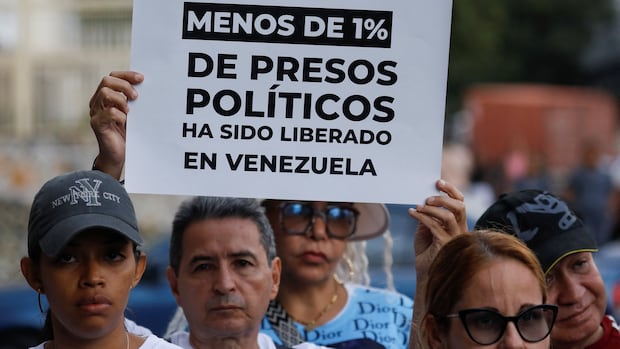
Disappointment in Caracas: A Missed Opportunity for Political Prisoners
On the streets of Caracas, the disappointment was palpable on Friday as the anticipated release of political prisoners failed to meet expectations. Despite promises from Jorge Rodriguez, the Chavista president of the National Assembly, that a “significant” number of detainees would gain their freedom, the reality was far less encouraging. By Friday afternoon, only nine individuals were freed from the notorious Helicoide and other prisons, leaving 811 still incarcerated, according to Foro Penal, an NGO specializing in advocacy for political prisoners.
Early speculation suggested that Juan Pablo Guanipa, one of the foremost opposition leaders, would be among those released. However, as the day progressed, hope transitioned into despair for many, including Guanipa’s childhood friend, Luz Urdaneta, who resides in Calgary. “It’s just hard to believe that somebody so hard-working and so dedicated to the well-being of the country is a prisoner, and without contact, without rights,” she expressed to CBC News, reflecting the frustration shared by many families affected by Venezuela’s political turmoil.
The Context of Guanipa’s Imprisonment
Guanipa’s arrest came amid his active involvement in the 2024 election campaign for opposition candidates Edmundo Gonzalez and Maria Corina Machado. Once a governor of Zulia state and vice-president of the National Assembly, his detention drew criticism from international figures, including U.S. Secretary of State Marco Rubio, who labeled it as “unjustified and arbitrary.” He reiterated the U.S.’s commitment to supporting the restoration of democracy in Venezuela and the release of political prisoners.
However, recent developments indicate a shift in the Trump administration’s approach toward Venezuela. Following the operation to capture Nicolás Maduro earlier this month, the administration’s focus seems to have veered from immediate action regarding political prisoners to a phased plan involving the stabilization and recovery of the country.
Changing Dynamics in U.S.-Venezuela Relations
This change in tone has created apprehension among Venezuelans both at home and abroad. Urdaneta, along with many others, supported the efforts to unseat Maduro but now questions the intentions behind U.S. policies. She noted that Trump’s recent comments about a prolonged U.S. presence in Venezuela raised doubts regarding the credibility of American promises regarding democratic governance. “We’re all expecting them to follow what they promised… a democratic country with free elections, beneficial to all Venezuelans,” Urdaneta asserted.
The hesitancy observed in the U.S. decision-making could have far-reaching consequences for political prisoners who continue to endure harsh conditions. Many of them have experienced torture and severe mistreatment during their imprisonment, raising urgent moral questions about the delay in releasing these detainees.
Family Heartbreak and Ongoing Struggles
For families of the imprisoned, the emotional toll is immense. Alongside Urdaneta, Oswaldo Garcia’s family in Montreal grappled with a similar sense of heartbreak when he was not released as part of the announced amnesty. Once a colonel in Venezuela’s National Guard, Garcia has been accused of plotting rebellion against the Maduro regime, and his family has not contacted him for two years. His son emphasized that addressing the plight of political prisoners must be the top priority for any meaningful change in Venezuela. “Political prisoners have to be step number one. It’s going to start healing a country,” he stressed.
Local Reactions and Broader Implications
As family members await changes, there is a palpable frustration directed at both the Maduro regime and the American administration, which many feel is not seizing the opportunity to effect real change. Venezuelans, like Jorge Robles, have expressed concern that the focus on exploiting Venezuela’s natural resources might overshadow the pressing need for genuine democratic reforms. Indeed, while U.S. officials tout the potential for economic leverage, many Venezuelans share the sentiment that human rights and democracy should be the foremost concerns.
Navigating the Future
As the political landscape in Venezuela remains fraught with uncertainty, discerning what comes next for the political prisoners becomes increasingly complex. The dialogue surrounding U.S. intervention has shifted, with stronger emphasis placed on resource control rather than democratic principles. Though promises of liberation loom in the air, for families, friends, and supporters of the detained, the question remains: when will real progress be made?
As hopes for the release of political prisoners dim, it becomes clear that the broader aspirations of Venezuelans—freedom, democracy, and an end to suffering—continue to hang in a precarious balance amidst political gamesmanship.

Venezuela’s Pledge to Release Political Prisoners Leaves Families in Waiting

The Most dramatic cats moments ever! 😂🤣 Funny Cat Videos 2025

Jennette McCurdy shares the stories behind memoir “I’m Glad My Mom Died”

Riding Back into Politics: Nathan Fletcher Takes on Role as Statehouse Lobbyist

Who Is Really Voting in These Polls? The Shocking Truth Behind America’s Approval Numbers

Blueprint for a “Tax-Free America” That Actually Works

Guidelines for Press Releases in Genomic Research and Medicine: A Collaborative Framework Developed with Public Contributors in Japan

Incremental Raises Won’t Fix a Broken System: $15 an Hour Is Still Too Low

Trump to Meet Venezuelan Opposition Leader and Nobel Laureate Maria Corina Machado – Live Updates on US Politics | US News

Trump Ambiguity on U.S. Military Action As Iran Promises Not to Execute Protesters

EXCLUSIVE: Will Smith’s Former Best Friend Bilaal Breaks Silence in Explosive Tasha K Interview — Lawsuit, Scientology Allegations, and Claims of an Attempt on His Life

Four Forecasts for 2026

Carbon Industries Group Signs Major Carbon Credit Agreements with Senegalese Government | Currency News | Financial and Business Insights

Top Picks from CES 2026: Editors Select the Best Products and Technologies

Elon Musk’s Return to Politics: Why Not Explore a New Hobby Instead? | Arwa Mahdawi

Wall Street Sees Modest Gains in Unsteady Start to 2026 | News, Sports, Jobs

Best Of The Funny Animal Videos 😹🐶 Funniest Cat & Dog Moments Ever Recorded 🤣

Trump Issues Order Pausing Offshore Wind Projects for a Minimum of 90 Days

Nvidia’s Groq Acquisition Highlights How the AI Chip Leader Leverages Its Robust Balance Sheet to Maintain Dominance

Top 2026 NFL Draft Targets for the Chiefs: Kenyon Sadiq and Jeremiyah Love Lead the Way for Patrick Mahomes and Andy Reid
The Most dramatic cats moments ever! 😂🤣 Funny Cat Videos 2025
Jennette McCurdy shares the stories behind memoir “I’m Glad My Mom Died”

Splash Dogs Take Over The Pool…And We Love It! | Dodo Kids | 1 Hour Of Animal Videos

The Funniest Animal Videos Compilation 😹🐶 Crazy Funny Dogs That Will Make You Laugh Nonstop 🤣

#54 Funniest Cats And Dogs videos 🐶🐱 #funny #animals #cuteanimals

Hilarious Animal Videos to Make You Laugh | Funny Dog & Cat Videos

Super Crazy Pets | FUNNIEST Animals You Have Ever Seen

Funniest Farm Animals

Funny Animal Videos 2023 – Comedy Voiceover! #12😹🐶🤣
Best Of The Funny Animal Videos 😹🐶 Funniest Cat & Dog Moments Ever Recorded 🤣
-
 Entertaiment2 weeks ago
EXCLUSIVE: Will Smith’s Former Best Friend Bilaal Breaks Silence in Explosive Tasha K Interview — Lawsuit, Scientology Allegations, and Claims of an Attempt on His Life
-
 Finance2 weeks ago
Four Forecasts for 2026
-
 Finance1 week ago
Carbon Industries Group Signs Major Carbon Credit Agreements with Senegalese Government | Currency News | Financial and Business Insights
-
 Technology3 days ago
Top Picks from CES 2026: Editors Select the Best Products and Technologies
-
 Politics1 week ago
Elon Musk’s Return to Politics: Why Not Explore a New Hobby Instead? | Arwa Mahdawi
-
 Business2 weeks ago
Wall Street Sees Modest Gains in Unsteady Start to 2026 | News, Sports, Jobs
-
 US News3 weeks ago
Trump Issues Order Pausing Offshore Wind Projects for a Minimum of 90 Days
-
 Technology3 weeks ago
Nvidia’s Groq Acquisition Highlights How the AI Chip Leader Leverages Its Robust Balance Sheet to Maintain Dominance